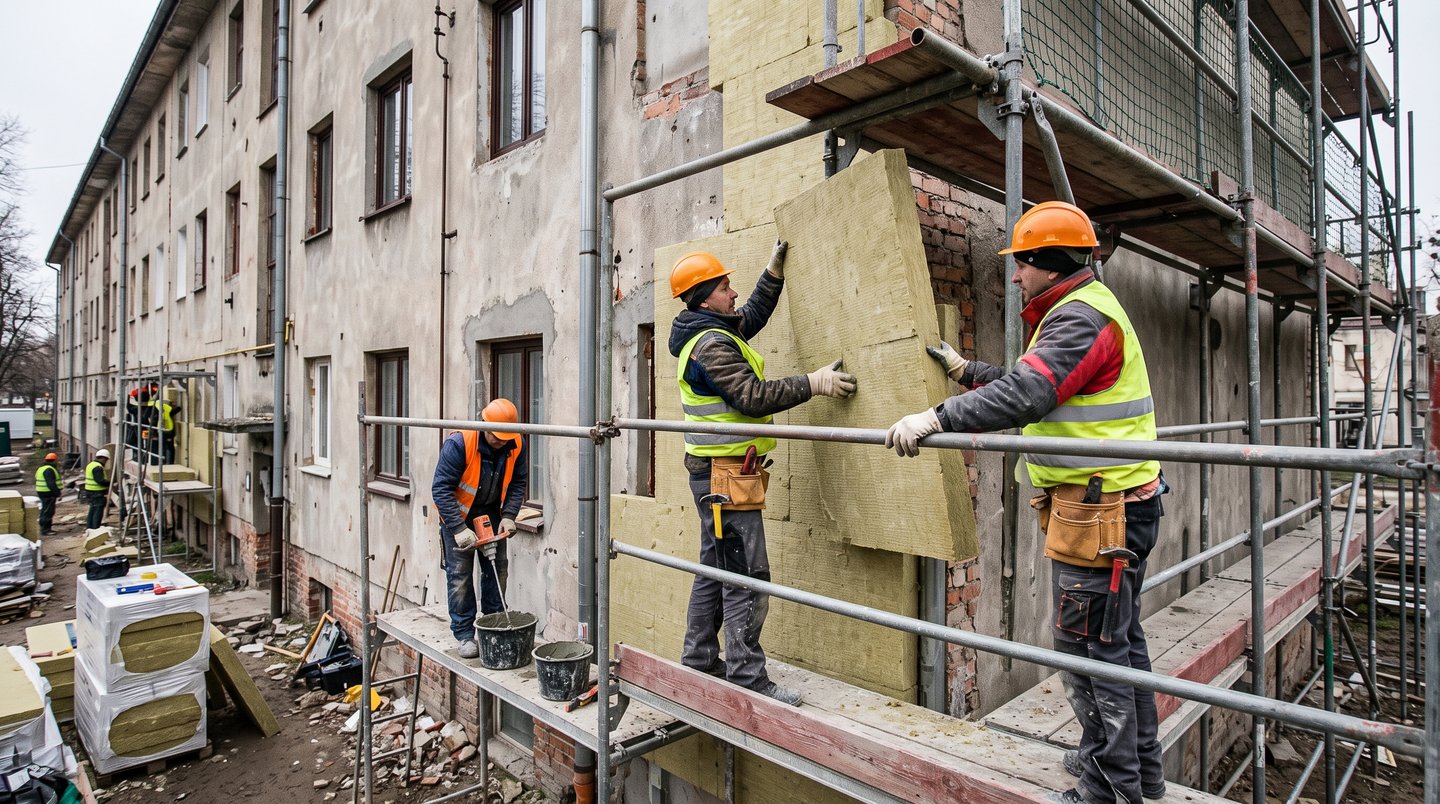
Climate politics runs on announcements. A hydrogen valley, a gigafactory, an offshore wind auction with a number large enough to print. Meanwhile the least photogenic option on the table, energy efficiency retrofits, keeps delivering more emissions reduction per euro than almost anything a minister will stand in front of, and keeps being the first line cut when a budget gets tight.
Buildings account for roughly 40 percent of energy consumption in the European Union and about a third of its energy related emissions. Most of those buildings are already standing, most of them will still be standing in 2050, and a large share of them leak heat through walls and windows designed when fuel was cheap. There is no version of the 2050 target that does not involve fixing them.
Why Energy Efficiency Retrofits Keep Losing the Argument
The problem is not evidence. It is that the benefits are diffuse, delayed and invisible. A wind farm produces a ribbon cutting and a photograph. Insulating 40,000 flats produces a slightly lower heating bill for 40,000 households who mostly do not know why, spread across four years and six contractors.
Political economy punishes that shape. The costs are upfront, concentrated and paid by identifiable people, usually landlords or homeowners. The savings are spread thin and arrive later, often to a different occupant. Economists call this the split incentive problem and it is the single biggest reason retrofit programmes underperform their own forecasts.
What the Evidence Actually Shows
Ex post evaluations of retrofit schemes tend to find real savings that are smaller than the engineering models predicted. The gap is well documented and has two causes. The first is modelling optimism, because simulations assume a level of installation quality that busy contractors do not always deliver. The second is the rebound effect: households that could not previously afford to heat the back bedroom start heating it.
The rebound finding is often reported as a failure. It is not. A cold home made warm is a health outcome and a poverty outcome, even where it is not a carbon outcome. Evaluations that count only kilowatt hours saved will systematically undervalue programmes aimed at low income housing, and policy designed from those evaluations will aim at the wrong stock.
Audits Are Cheap, and Still Skipped
An energy efficiency audit costs a few hundred euros and reliably changes what gets done. Without one, households default to the visible measures, new windows and a new boiler, when the cost effective sequence usually starts with loft insulation, draught proofing and controls. The order matters: installing a heat pump into an unimproved envelope oversizes the unit, raises the bill and produces a disappointed customer who then tells everyone they know.
Programmes that fund audits separately from works consistently outperform those that do not. This is one of the clearer findings in the literature and one of the most frequently ignored in scheme design, largely because audit funding looks like administrative overhead on a spreadsheet.
The Regulatory Layer Is Finally Catching Up
The recast Energy Performance of Buildings Directive moved the framework from encouragement to obligation, with national renovation plans, targets for the worst performing stock and a zero emission standard for new construction. The Commission's renovation wave strategy set the ambition of doubling annual renovation rates, which remains a long way from current delivery in most member states.
Targets are not the binding constraint. Installer capacity is. A country that announces a tripling of retrofit volumes without a matching training pipeline gets price inflation and poor workmanship rather than warm homes, and the poor workmanship then poisons public appetite for the next scheme.
Communication Is a Policy Instrument, Not a Postscript
Retrofit programmes are unusually dependent on households understanding and trusting them. That makes plain language, and the availability of information in the languages people actually speak at home, a delivery question rather than a courtesy. Uptake studies repeatedly show that complexity, not cost, is the first barrier households cite.
Policymakers in multilingual jurisdictions have been slow to treat this as measurable. The debate around language access legislation is instructive here, because it frames translation as infrastructure for programme participation rather than as compliance paperwork. The same logic applies to a renovation grant form that only exists in the majority language.
What a Serious Programme Looks Like
Four things separate schemes that work from schemes that announce. Multi year funding, so contractors will hire and train. Mandatory audits, funded. Quality assurance with real inspection, not self certification. And targeting by building performance rather than by household enthusiasm, because the worst stock is rarely owned by the people who apply first.
None of this will headline a campaign. It is unglamorous, administratively heavy work that shows up years later as a slightly flatter emissions curve and slightly fewer winter deaths. Households are endlessly told that reducing their carbon footprint is a matter of individual choice, when the largest single lever in most of their lives is the fabric of the building they live in, and that lever is held by a government department. Evidence based policy means putting money where the measured returns are, even when the returns cannot be cut a ribbon.